
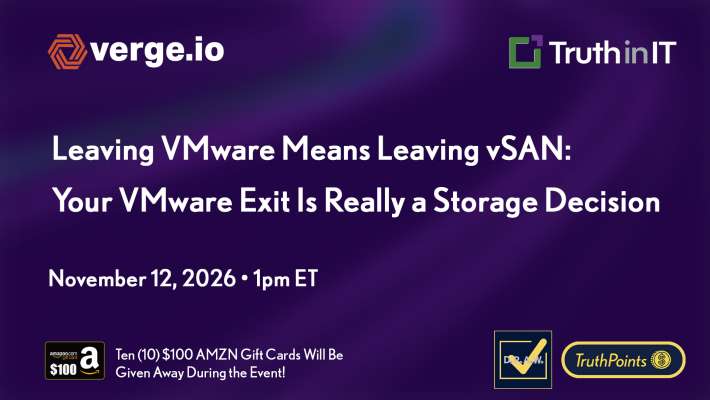
Leaving VMware Means Leaving vSAN: Your VMware Exit Is Really a Storage Decision
Sign In
Most VMware exit plans start with the hypervisor. For organizations running vSAN, the hypervisor is the easy part. vSAN ships as part of the VMware stack, so leaving VMware also means leaving the storage layer that holds every production VM. A hypervisor migration becomes a storage migration, and few exit plans account for it.
vSAN customers have three realistic paths. They can rebuild on another vendor's HCI stack and accept a new form of lock-in. They can return to the external SAN they spent years retiring. Or they can move to an infrastructure operating system that runs compute, storage and networking in a single code base. Each path comes with its own cost, migration timeline and hardware impact.
In this session, George Crump, founder of Storage Switzerland, and Dave Vincent walk through each option in the detail IT architects need to make the call. George draws on his years covering storage as an industry analyst to frame the tradeoffs. Together they cover how vSAN data moves off VMware, which servers you can keep in production and how to avoid a second refresh cycle a year after the first. Dave closes with a demonstration of the migration process from his lab.
Attendees Will Learn
- Why vSAN customers face a harder VMware exit than SAN customers
- What each exit path costs in licensing, hardware and migration effort
- How to move vSAN workloads onto existing servers and skip the second refresh
-
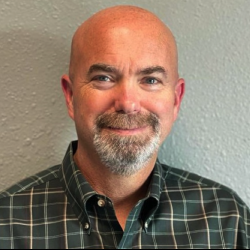
 David Vincent - Technical Solutions Strategist, Verge.io
David Vincent is a Technical Solutions Strategist at Verge.io, where he helps organizations rethink their infrastructure — moving off legacy virtualization and HCI platforms and onto VergeOS, a single-codebase private cloud operating system that runs on commodity hardware. He's a hands-on technologist known for turning complex ideas into practical demos, from live VM migrations driven by plain-English AI commands to building private AI servers on consumer GPUs.
David brings more than two decades of enterprise IT experience, including 20+ years as a systems architect and senior technical specialist at Algoma Steel, where he ran real-world virtualization, storage, and data center environments at scale. That operator's perspective — plus a deep VMware background — shapes how he talks about modernization: not as a rip-and-replace exercise, but as a way for teams to take back control of their stack, their costs, and their data. Based in Sault Ste. Marie, Ontario, he's a frequent voice on VMware alternatives, private AI, and infrastructure modernization.
-
George Crump - Chief Marketing Officer, Verge.ioGeorge Crump brings over three decades of experience to his role as Chief Marketing Officer (CMO) at VergeIO. Before joining VergeIO, Crump was the founder and lead analyst at Storage Switzerland, an independent IT research firm specializing in storage, backup virtualization, and cloud markets, a position he held for 14 years. His work there established him as a prominent voice in the field, focusing on providing practical insights and solutions to data center challenges. George also served as CMO and Chief Product Strategist at StorONE, an enterprise storage software provider.
In his role at VergeIO, Crump is tasked with evangelizing the VergeOS software, positioning it as a superior alternative to legacy hyperconverged infrastructure (HCI) and public cloud solutions. His approach aligns with his long-standing advocacy for reducing the cost and complexity of virtualization, storage, and networking infrastructures. Crump's insights and strategies are geared towards addressing critical IT issues like cost control, scaling to meet performance and capacity demands, and simplifying IT infrastructures.